Interview
Guide
Does Microlearning Work? What the Research Says
Yes, microlearning works when it is designed around one clear objective, includes active practice, and is spaced over time. It draws on well-established learning science: spacing, retrieval practice, and managing cognitive load. It does not work as a shortcut. Short content without focus, practice, or reinforcement produces the same weak results as long content.
Experts and client results on microlearning effectiveness
5 videos. Click any card to play it here.
Case study
The HPNA Success Story: 1573% Utilization
Case study
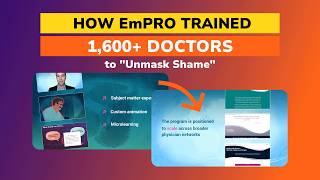
How EmPRO Trained 1,600+ Doctors to "Unmask Shame"
Case study
Building OCP Academy: Reaching Thousands in Just 6 Months
Interview
The smart way to design Microlearning | Erick Prospero ft. Robyn Defelice
Does microlearning work?
Microlearning works when it applies proven learning principles: one focused objective per unit, active practice, and repetition spaced over time. Evidence from learning science supports each of those ingredients. Shortness alone is not the active ingredient. A focused three-minute scenario with follow-up questions works; a three-minute slice of a lecture usually does not.
That distinction matters, because much of the debate about microlearning mixes up two things. One is the design approach, built on decades of research about how people learn and remember. The other is the marketing claim that anything short is automatically better.
We have built microlearning for associations, medical societies, healthcare organizations, and companies since 2016. Our experience matches what the research suggests: the programs that work are the ones designed around real behavior, not the ones that are simply short.
What does learning science say about microlearning?
Learning science supports the core mechanics of good microlearning: spacing practice over time, retrieving information from memory, limiting cognitive load, and pairing words with relevant visuals. These principles are among the most replicated in educational research. Microlearning makes them easier to apply because short units can be revisited, quizzed, and scheduled.
| Principle | What the research shows (in general terms) | How microlearning applies it |
|---|---|---|
| Spacing effect | Learning spread over time is retained longer than the same learning crammed into one session | Short units released or revisited over days and weeks |
| Retrieval practice | Recalling information strengthens memory more than rereading it | Quick quizzes, scenario decisions, and follow-up questions |
| Cognitive load | Working memory is limited; too much new information at once hurts learning | One objective per unit, minimal extraneous content |
| Multimedia principles | People learn better from relevant words plus visuals than from words alone | Animation, diagrams, and video tied directly to the concept |
| Forgetting curve | Without review, people forget much of what they learn fairly quickly | Planned reinforcement after the initial unit |
[VERIFY: cite a study on the spacing effect] [VERIFY: cite a study on retrieval practice (testing effect)] [VERIFY: cite a study or review on cognitive load theory] [VERIFY: cite Mayer’s multimedia learning research] [VERIFY: cite a study directly evaluating microlearning outcomes in workplace or professional education]
Notice what the research does and does not say. It supports spacing, retrieval, focus, and good visuals. It does not say that a two-minute video is inherently better than a twenty-minute one. In our interview with Nidhi Sachdeva, PhD, who wrote her doctoral thesis on microlearning, length and structure come up as a cognitive load question, not a rule of thumb.
Is microlearning effective for changing behavior?
Microlearning is effective for changing behavior when each unit targets a specific action, includes practice in a realistic context, and is reinforced after launch. Behavior change depends on practice and support systems more than on content delivery. Scenario-based units that mirror real decisions are the most reliable format we have found for this goal.
Learning strategist Robyn Defelice makes this point in our interview with her: shorter content does not automatically lead to better outcomes, and completion rates are a poor stand-in for business impact. She separates knowledge-based, skill-based, and performance-based microlearning. Each needs different design and different evidence of success.
In practice, effective behavior-focused microlearning tends to share these traits:
- It starts from a real situation the learner faces, such as a clinical conversation, a safety decision, or a customer call.
- It asks the learner to choose or do something, not just watch.
- It gives feedback that explains consequences.
- It comes back later, through spaced questions or follow-up units.
- It connects to managers, peers, or tools that support the behavior on the job.
For examples of scenario-based design in action, see our safety training microlearning examples and AI roleplay and simulation examples.
When does microlearning fail?
Microlearning fails when it is treated as a format shortcut instead of a design approach. Common failure patterns include units that try to cover too much, content with no clear action, no practice or feedback, no reinforcement after launch, and success measured only by completions. It also fails for goals that need deep, sequential learning.
In our conversation with Kirstie Greany, Head of Learning Strategy at Alucidat, we worked through several myths. Microlearning does not have one universal definition. It does not automatically solve learner overwhelm. It is not inherently more engaging. And it does not work for every learning objective.
The failure modes we see most often:
| Failure pattern | Why it fails | Fix |
|---|---|---|
| Long course chopped into pieces | Same content, same passive experience | Redesign around actions, not chapters |
| Several objectives per unit | Exceeds what learners can absorb at once | One objective per unit |
| Watch-only content | No retrieval or practice | Add decisions, questions, or tasks |
| Launch and forget | Forgetting sets in without review | Schedule spaced reinforcement |
| Completion as the only metric | Hides whether anything changed | Measure confidence, behavior, and outcomes |
| Wrong goal for the format | Complex skills need extended practice | Use a blended program |
If you are deciding between formats, our comparison of microlearning vs traditional learning covers when longer formats still win.
What results have real microlearning programs achieved?
Real microlearning programs we built have produced measurable results: HPNA saw a 1,573% increase in utilization, EmPRO trained over 1,600 physicians with confidence gains of 15 to 18 percentage points, and OCP Academy reached thousands of learners in six months. Each program paired short, focused units with a clear audience and goal.
| Client | Audience | Approach | Reported results |
|---|---|---|---|
| HPNA (Palliative Care Basics series) | Hospice and palliative clinicians | Scenario-based microlearning built for learning between shifts | 1,573% increase in utilization; 90% learner satisfaction |
| HPNA (POLARIS program) | RNs, APRNs, pediatric palliative care specialists | Short modules with CE credit, scenario-based video, mobile and desktop access | 930+ learners in the first 4 months; 96% of APRNs met learning objectives; 86% said it enhanced professional growth |
| EmPRO (“Unmasking Shame”) | Physicians | CME-accredited course with SME-led video, custom animation, and scenario-based microlearning | 1,600+ physicians completed; confidence up 15 to 18 percentage points across nine competencies |
| OCP Academy | Global data center and technical workforce | Technical specs turned into video and interactive diagrams | Thousands of learners in the first six months; learners completing multiple modules |
These numbers come from the programs themselves, not from controlled experiments, so treat them as real-world evidence rather than proof that microlearning beats every alternative. [VERIFY: baseline used to calculate HPNA’s 1,573% utilization increase] What they do show is that focused, practical, well-designed short units can reach busy professionals at scale and change how confident they feel in real situations.
Read the full stories in the HPNA case study, the EmPRO case study, and the OCP Academy case study.
How can you make sure your microlearning works?
Make microlearning work by designing for one action per unit, building in practice and feedback, scheduling spaced reinforcement, and deciding how you will measure success before production begins. Prototype one unit with real learners first. These steps cost little up front and prevent the most common reasons microlearning programs fail.
A short checklist:
- Write each objective as an observable action.
- Use a realistic scenario or example from the learner’s actual work.
- Include at least one decision or retrieval moment per unit.
- Plan reinforcement for the weeks after launch.
- Collect confidence or knowledge data before and after.
- Look for behavior or outcome data tied to the original problem.
For the full process, follow our guide on how to implement microlearning, and use how to measure microlearning ROI to build your evaluation plan.
Is microlearning more effective than traditional training?
Microlearning is more effective for some goals and less effective for others. It tends to outperform long courses for specific, practical behaviors and for reinforcing what people already learned. Long-form or blended programs are usually better for deep foundational knowledge and complex skills that build in sequence. The right answer depends on the objective, not the format.
Does microlearning improve retention?
Microlearning can improve retention when it uses spaced repetition and retrieval practice, two of the most reliable findings in learning science. Short units make it practical to revisit content over days or weeks and to quiz learners on key points. A single short video watched once, with no follow-up, offers little retention advantage over anything else.
Why does microlearning sometimes fail?
Microlearning usually fails for design reasons: units that cover too much, content with no practical action, no practice or feedback, and no reinforcement after launch. It also fails when organizations measure only completions and assume short means effective. Fixing those design gaps matters more than the exact length of each module.
Is microlearning effective for healthcare professionals?
Microlearning suits healthcare professionals well because clinicians and physicians learn between demanding shifts and need practical, scenario-based content. Our HPNA program for hospice and palliative nurses saw a 1,573% increase in utilization, and EmPRO's physician program reached over 1,600 doctors with measurable confidence gains across nine competencies.
How can I prove my microlearning program works?
Decide on success measures before you build. Track reach and completion, then add pre and post confidence or knowledge questions tied to each objective, and look for behavior or outcome data connected to the original problem. Comparing results with a previous program or a pilot group makes the case far stronger than completion rates alone.
Does microlearning work for associations?
Microlearning works well for associations because members are busy professionals who choose whether to engage. Short, relevant, credit-bearing units fit their schedules and can support certification, onboarding, and continuing education. The OCP Academy reached thousands of global learners in its first six months, with learners completing multiple modules.
Work with us
Build microlearning that shows results
Tell us what outcome you need to prove, and we will help you design a program with measurement built in from day one.
- Built by the team behind every example on this site
- Brandon Hall Group and ASAE award-winning work
- Associations, healthcare, nonprofits, and tech
Related