Experiment
The Lab
The Microlearning Lab: Experiments in AI Microlearning and Interactive Learning
The Lab is where Ninja Tropic tests AI microlearning and interactive techniques on real learning problems and reports what happened. Each experiment names the problem, the constraint, and the tools (Google Veo, Synthesia, ElevenLabs, Google AI Studio, Articulate Storyline), then gives an honest verdict on when to use the approach and when to skip it.
Lab experiment videos
10 videos. Click any card to play it here.
Experiment
Softskill Training Video Production with AI (Here's what happened)
Experiment
Best AI Video Generators for Patient Education Cases
Experiment
Google Veo for Patient Education Microlearning: AI Video Creation Step-by-Step
Experiment
The AI SIM Blueprint
Experiment
AI voice over can either elevate an eLearning experience or completely break it.
Experiment
Behind the Scenes: Building Realistic AI Video for Customer Service Training
Experiment
How to Build a 360° Interactive Learning City in Articulate Storyline with Hotspots & Microlearning
Experiment
AI-Generated Video & Interactive Storytelling Example for Real eLearning Scenarios | Google Veo 3
Experiment
AI Microlearning Video Example for Cybersecurity: Enhancing Visuals with Sora & Adobe After Effects
What is the Microlearning Lab?
The Microlearning Lab is where the Ninja Tropic team tests new AI and interactive techniques on real learning problems before we recommend them. Each experiment documents the question, the setup, what we built, what happened, and a plain verdict. The goal is to show you what AI microlearning can do today, including the parts that fail.
We build custom eLearning, video, and microlearning for associations, medical societies, healthcare organizations, nonprofits, and technology companies. New AI tools appear every week, and most demos show only the best frame. We would rather test a tool on a real problem, with a real constraint, and tell you what we found.
Every experiment also appears as a video on our YouTube channel. The gallery above collects them.
How do we run each experiment?
Every Lab experiment follows the same four-part structure: a real learning problem, a real constraint, the specific tools we used, and an honest verdict. We date-stamp each test because AI tools change fast. A result from early 2026 may not hold a year later, so you should know exactly when we tested.
| Step | What we document |
|---|---|
| Learning problem | The skill or knowledge gap, such as de-escalation or patient aftercare |
| Constraint | What made it hard: no developer, no filming on location, clip limits |
| Tools | The exact tools and the month we tested them |
| What we built | The finished piece, shown on video |
| What happened | What worked, what didn’t, what needed human correction |
| Verdict | A “use it when, avoid it when” table you can apply to your own project |
Where we lack a number, such as build hours or learner results, we say so rather than guess. Our editorial policy explains how we select and review examples.
What have we tested so far?
So far we have tested AI roleplay, AI character animation, five AI video generators, AI video with branching, AI voiceover, realistic AI video for customer service, and 360-degree Storyline environments. Each summary below links to the full experiment, with the setup, results, and our verdict on when the approach fits.
AI roleplay simulator for de-escalation training
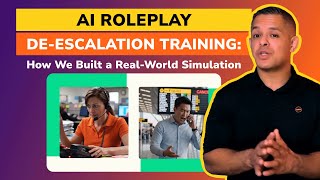
We built a custom AI roleplay simulator in Google AI Studio, with no developer and no paid platform, where learners calm a frustrated Horizon travel customer. It embeds in Articulate Rise or Storyline. The finding: design decisions, not technology, decided quality. Read the AI roleplay training experiment.
Can AI replace character animation for soft skills training?
We rebuilt a real harassment prevention video for the Cornerstone Foundation with AI character animation. AI sped up asset creation but struggled with character consistency and lip sync. A hybrid workflow, with storyboards and animators in charge, won. Read the AI soft skills video production experiment.
AI video generators for patient education
We made the same patient education video five ways (motion graphics, Synthesia, Google Veo, OpenAI Sora, Adobe Firefly) and asked over 100 patient education leaders which would work. Realism helped and added risk. Read the AI video for patient education experiment.
Google Veo 3 and branching scenarios
We generated an AI client named Julia in Google Veo 3 and built a branching conversation in Storyline about a request for an extra feedback round. Reusing one visual prompt kept her consistent. Read the Google Veo branching scenario experiment.
AI voiceover in eLearning
For The Wonderful Company’s driver training in Fiji, we used ElevenLabs voice cloning to create local voices we could not record in person. AI voice worked as part of full localization, and breaks as generic narration. Read the AI voiceover experiment.
Realistic AI video for customer service training
We used Google Veo, Director’s Notes, and idle loops to create a believable upset customer, working around Veo’s 8-second clips at the time. Read the AI video for customer service experiment.
A 360-degree interactive learning city in Storyline
We built a Street View-style learning hub in Articulate Storyline with 360 images, hotspots, tooltips, and layered microlearning. Structure and naming mattered more than effects. Read the 360 learning city experiment.
Earlier tests, such as using Sora footage with Adobe After Effects for cybersecurity microlearning, appear in the gallery above.
What have the experiments taught us about AI microlearning?
Across every experiment, the same pattern held: AI microlearning tools speed up production, but they move the work rather than remove it. Storyboards, Director’s Notes, system instructions, and clinical or expert review decided whether the output was usable. Teams that skip instructional design get faster content that teaches less.
A few lessons repeat across experiments:
- Define behaviors before you build. Our AI SIM Blueprint and SIM Creator tool grew out of this.
- Consistency is the hardest problem for AI characters, in both animation and video.
- Realism raises the stakes, especially in healthcare content.
- Use AI to make content more specific, such as local voices or brand-matched scenes, not more generic.
For finished, client-ready work using these techniques, see our AI-generated training video examples and AI roleplay and simulation examples.
What are we testing next?
Our next experiment is an AI-generated 360 escape room for clinicians, built in Articulate Storyline and set in a hospital. It tests whether AI-generated 360 images are believable enough for clinical audiences, and whether an escape room format gives real problem-solving practice. Results will publish when the experiment is complete.
Read the plan and what we will measure on the AI 360 escape room experiment page. Other planned tests include pairing our AI roleplay simulator with AI video of the same customer, and measuring learner response to AI-animated characters [VERIFY: confirm upcoming experiment list and order].
If there is a tool or technique you want us to test, tell us through the contact page.
What is AI microlearning?
AI microlearning is short, focused learning content where AI helps create or deliver it: generating video scenes, voices, images, or interactive practice like AI roleplay. The microlearning principles stay the same: one objective, a few minutes, and a clear action. AI changes how fast and how specifically you can produce it, not what makes it work.
Can AI create microlearning on its own?
Not well, in our testing. AI tools produced useful video, voices, images, and simulations quickly, but the quality was decided by human work around them: learning outcomes, scripts, storyboards, Director's Notes, and review. Across our experiments, AI changed where the work happened rather than removing it. Treat AI as a production accelerator inside an instructional design process.
Which AI tools have you tested for eLearning?
Our published experiments cover Google Veo and Veo 3 for video, Synthesia for AI presenters, OpenAI Sora and Adobe Firefly for generated video, ElevenLabs for voice cloning, Google AI Studio for an AI roleplay simulator, and Sora with Adobe After Effects for cybersecurity visuals. Each experiment page states when we tested, because these tools change quickly.
Are the Lab experiments real client projects?
Some are and some are built scenarios. The AI voiceover test came from real driver training for The Wonderful Company, and the soft skills animation test rebuilt a real harassment prevention video for the Cornerstone Foundation. Others, like the Horizon travel scenarios, use a fictional brand so we can test freely. Each page says which.
How do you decide if an experiment worked?
We judge each experiment against the learning problem, not the technology. That means asking whether the output is accurate, believable to the audience, practical for a real team to produce and maintain, and focused on observable behavior. Every page ends with a verdict table showing when to use the approach and when to avoid it, including limitations.
Newsletter
Get new experiments first
We publish each experiment with the setup, the results, and what we'd change. Subscribe and get the next one before it hits YouTube.