Case study
Industry
Medical Society and CE Microlearning Examples
Medical society CE microlearning breaks continuing education into short, scenario-based modules that nurses and physicians can complete between clinical duties while still earning CE or CME credit. The examples below include HPNA's palliative nursing programs, EmPRO's CME course completed by 1,600+ physicians, and SCCT's training for cardiovascular imaging professionals.
Medical society and CE microlearning examples
10 videos. Click any card to play it here.
Case study
HPNA: Modern, Interactive Microlearning for Hospice & Palliative Nursing Education | Case Study
Case study
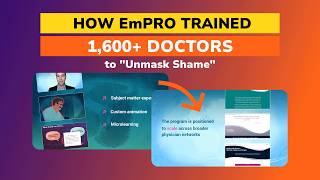
How EmPRO Trained 1,600+ Doctors to "Unmask Shame"
Example
Medical Training Example with Engaging Articulate Rise 360 Incorporating Level 2 Interactivity
Case study
Insightful Customer Training Example for Healthcare Industry: SCCT's Success Story
Example
Patient Education Training Example for Nonprofit & Associations | Inteleos
Example
Patient Education Training Example for Education Industry | Indiana University
Example
Technical Training Example for Medical Industry | SSCT
Example
Patient Education Microlearning: 8 Examples That Drive Real Behavior Change in Healthcare
Example
Best Association LMS Review: An Unfiltered Review of Oasis LMS
Why do medical societies use microlearning for CE?
Medical societies use microlearning for CE because their members are practicing clinicians with little free time and strict credit requirements. Short, scenario-based modules let nurses and physicians learn in the gaps of a clinical day, while a well-structured series still meets accreditation standards and adds up to meaningful credit hours.
There is also a business reason. CE is one of the clearest products a medical society sells, and members compare it against free or cheap alternatives. A modern, mobile, case-based program stands out against a catalog of recorded lectures, and it is easier to update when guidelines change.
Finally, microlearning suits the kind of learning clinicians need most: judgment in context. A short scenario that asks “what would you do next?” practices clinical reasoning more directly than an hour of slides.
What to notice in these medical society microlearning examples
The examples above share three design choices: they start from real clinical situations, they treat emotional and communication skills as seriously as technical knowledge, and they connect each module to a measurable outcome. Each also fits a specific audience, from palliative nurses to cardiovascular imaging specialists.
HPNA, Palliative Care Basics. The Hospice and Palliative Nurses Association faced a critical workforce shortage and no standardized training for new clinicians. The Palliative Care Basics eLearning series used scenario-based microlearning built for clinicians working between shifts. The results: a 1,573% increase in utilization and a 90% learner satisfaction rate.
HPNA, POLARIS. Developed with the Hospice and Palliative Nurses Foundation, POLARIS offers short modules with CE credits, scenario-based learning, and integrated DEIB video content, accessible on mobile and desktop. It serves registered nurses, APRNs, and pediatric palliative care specialists. Over 930 learners engaged in the first four months, 96% of APRNs reported meeting the learning objectives, and 86% of users said it enhanced their professional growth.
EmPRO, Unmasking Shame. EmPRO, a medical professional liability insurer, partnered with us on a CME-accredited course that helps physicians recognize and manage shame in clinical settings, a hidden factor in decision-making, burnout, and patient safety. The course combined SME-led video and custom animation with scenario-based microlearning. Over 1,600 physicians completed it, with confidence rising 15 to 18 percentage points across nine competencies tied to communication and error recovery.
SCCT. The Society of Cardiovascular Computed Tomography uses interactive online training for its global network of cardiologists, radiologists, and technologists. It is a good model for societies whose members span several professions.
The HPNA case study and EmPRO case study go deeper on design and results.
Common medical society CE microlearning formats
Medical societies typically use five formats for CE microlearning: scenario-based video cases, interactive Rise courses, expert-led video segments, patient communication simulations, and short refreshers between major courses. The right choice depends on the competency, the credit structure, and how often the content must be updated.
| CE need | Recommended format | Typical module length | Example above |
|---|---|---|---|
| Clinical judgment and decision-making | Scenario-based video with decision points | 5 to 10 minutes | HPNA Palliative Care Basics |
| Communication and emotional skills | SME-led video plus animation | 5 to 10 minutes | EmPRO Unmasking Shame |
| Foundational specialty knowledge | Rise 360 course with embedded interactions | 10 to 20 minutes per lesson | HPNA in Rise 360 |
| Multi-profession technical training | Interactive online modules | 5 to 15 minutes | SCCT |
| Patient-facing communication | Animated explainer clinicians can share | 1 to 3 minutes | Inteleos |
Lengths are general guidance. Your accrediting body’s rules decide how modules combine into credit. See more continuing education microlearning examples across industries.
How do you design CE microlearning clinicians trust?
Clinicians trust CE microlearning when it is accurate, practical, and respectful of their expertise. That means peer experts on screen, realistic cases instead of textbook ones, honest handling of hard topics such as error and grief, and assessments that test judgment rather than recall of trivia.
Some practical guidance from our builds:
- Lead with the case. Open each module with a clinical situation, then teach what the clinician needs to handle it.
- Use peer voices. SME-led video, as in EmPRO’s course, carries credibility that generic narration does not.
- Handle emotion directly. Topics like shame, burnout, and end-of-life conversations need careful tone. Treat them as competencies, not side notes.
- Write assessments that mirror practice. Ask what the clinician would do, say, or prioritize next.
- Make it mobile. HPNA’s programs were built for learners on the move, on mobile and desktop.
How should medical societies measure CE microlearning?
Measure CE microlearning on four levels: utilization (enrollments and completions), satisfaction, self-reported confidence or competence against objectives, and, where possible, practice change. The HPNA and EmPRO programs reported results across several of these levels, which made their value easy to explain to leadership and boards.
Before launch, define a baseline. HPNA could report a 1,573% increase in utilization because it knew where it started. EmPRO measured confidence before and after across nine competencies. Build these questions into your evaluation from the start, and track revenue and renewal behavior alongside learning data. Our guide to measuring microlearning ROI covers the metrics in detail.
How to get started
Choose one CE topic with clear demand and a clear gap, such as a new guideline, a workforce shortage area, or a communication skill members struggle with. Confirm accreditation requirements, recruit two or three clinical experts, and pilot a short series before committing to a full catalog rebuild.
If your society also serves hospital staff or patients, see our broader healthcare microlearning examples. For packaging, pricing, and non-dues revenue strategy, our association microlearning examples and guide to microlearning for associations apply directly to medical societies.
Can a microlearning course be accredited for CE or CME?
Yes. Accreditation depends on meeting your accrediting body's standards for needs assessment, objectives, content validity, assessment, and evaluation, not on module length. EmPRO's Unmasking Shame course was CME-accredited, and HPNA's POLARIS program offers CE credits through short modules. Plan accreditation requirements before scripting so the design supports them.
How do you calculate CE credit for short modules?
Most societies group short modules into a series and calculate credit for the whole activity, based on the estimated time to complete the content and assessments. Your accrediting body's rules decide the method. Build a pilot, time real learners, and document it. [VERIFY: confirm credit calculation method with the society's accreditation lead]
What results can a medical society expect from microlearning?
Results vary by program, but the examples here show what is possible. HPNA's Palliative Care Basics saw a 1,573% increase in utilization and 90% learner satisfaction. EmPRO reported confidence gains of 15 to 18 percentage points across nine competencies among 1,600+ physicians. Define your own measures before launch so you can compare.
Should clinical experts appear on camera in CE content?
When possible, yes. Clinicians trust peers they recognize, and SME-led video adds credibility that narration alone rarely matches. EmPRO's course combined SME-led video with custom animation. If experts cannot travel, short remote filming sessions or animated versions of the expert, as used in other association projects, can work well.
Is microlearning rigorous enough for advanced practice clinicians?
Rigor comes from the scenarios and assessments, not the length. HPNA's POLARIS program targets registered nurses, advanced practice registered nurses, and pediatric palliative specialists, and 96% of APRNs reported meeting the learning objectives. Short modules can carry complex clinical judgment when each one is built around a realistic decision.
Work with us
Plan your next CE program
Tell us about the clinical topic, audience, and accreditation you are working with. We'll share relevant examples and a realistic build plan.
- Built by the team behind every example on this site
- Brandon Hall Group and ASAE award-winning work
- Associations, healthcare, nonprofits, and tech